This page contains Amazon affiliate links. If you buy through them we may earn a commission at no extra cost to you. It does not change what we recommend — the two products we rate highest here are in different categories, and one of them is the cheapest thing on the list. How we make money →
Amdro vs Ortho vs Spectracide — The Framing Almost Everyone Gets Wrong
Search "Amdro vs Ortho" or "Amdro vs Spectracide" and you will find page after page comparing these products as though they are rivals doing the same job. They are not. Amdro and Spectracide One-Shot are both baits. Ortho's two products are contact killers. That difference decides which one you should buy.
Spectracide's own product page says it outright: the active ingredient kills worker ants slowly so they have time to carry the bait back to the queen, and because it is a bait, you will initially see more ants. That is the opposite of what the Spectracide brand is generally known for.
Amdro Fire Ant Killer for Lawns, Amdro Fire Ant Killer for Mounds, Spectracide One-Shot. Slow, carried home by workers, kills the queen and colonies you cannot see.
Ortho Orthene Fire Ant Killer (acephate) and Ortho Fire Ant Killer Mound Treatment (bifenthrin). Fast, kills what it reaches, treats only the mound you found.
The honest comparison is bait versus contact — and the correct answer for most yards is one of each, used in sequence.
The Five Products, Sorted Correctly
| Product | Active ingredient | Type | Role |
|---|---|---|---|
| Amdro Fire Ant Killer for Lawns | Hydramethylnon | Bait | Broadcast — whole yard |
| Amdro Fire Ant Killer for Mounds | Hydramethylnon 0.73% | Bait | Individual mounds |
| Spectracide One-Shot | Not named on retail listings — read the label | Bait | Broadcast or mounds |
| Ortho Orthene Fire Ant Killer | Acephate 50% (organophosphate) | Contact — dust | Individual mounds only |
| Ortho Fire Ant Killer Mound Treatment | Bifenthrin (pyrethroid) | Contact — granule | Individual mounds |
Confirm the active ingredient on the bag you actually buy. Manufacturers reformulate, and Amdro in particular sells similar-looking yard products with different chemistry.
Bait vs Contact, in One Table
| Bait | Contact | |
|---|---|---|
| How it works | Workers carry it into the mound and feed it to the queen | Kills the ants it reaches, in place |
| Speed | Days to weeks | Minutes to hours |
| Reaches the queen? | Yes — that is the point | Only if the product penetrates to her |
| Coverage | Kills colonies you cannot see, including new ones with no visible mound | Only the mound you found |
| More ants at first? | Yes — normal, and stated on the label | No |
| Weather sensitivity | High — temperature and rain both matter | Lower |
| Best for | Whole-yard suppression | The mound by the mailbox that has to go today |
The North Alabama Difference: You Probably Don't Have Red Imported Fire Ants
South Alabama has the classic red imported fire ant, Solenopsis invicta. From roughly the middle of the state northward, what you are dealing with is usually the hybrid of the red and black imported fire ants, S. invicta × richteri. USDA APHIS places this hybrid from the middle of Mississippi and Alabama northward into eastern Tennessee, and Virginia Tech Extension notes that hybrid fire ants appear more cold-tolerant than either parent species.
The practical news is reassuring: the treatment does not change. The same baits and the same mound products work. What changes is the calendar — a more cold-tolerant ant in a colder part of the state means your foraging window and application timing are the variables that matter, not your product choice.
| Factor | North Alabama reality |
|---|---|
| Cold limit | Mississippi State notes northern migration is likely limited by winter temperatures that freeze soil deeply enough to affect overwintering colonies. We are closer to that edge than Mobile is. |
| Colony density | Generally lower pressure than the Gulf Coast — which means a well-timed bait program has a better chance of actually holding. |
| Clay soils | Mounds may be taller and more durable in heavy clay than in sand. North Alabama clay produces the classic hard, tall mound. |
| Summer invisibility | Mounds typically appear in cool or moist weather and may be completely absent during Alabama's hot, dry summers. No visible mounds in August does not mean no ants. |
| Quarantine | Alabama is under the USDA imported fire ant quarantine, administered by ADAI. It regulates moving hay, soil, plants, sod and soil-moving equipment out of quarantined areas — background for a homeowner, a real requirement if you haul fill dirt or move equipment between properties. |
Product by Product
Amdro Fire Ant Killer for Mounds — bait, hydramethylnon
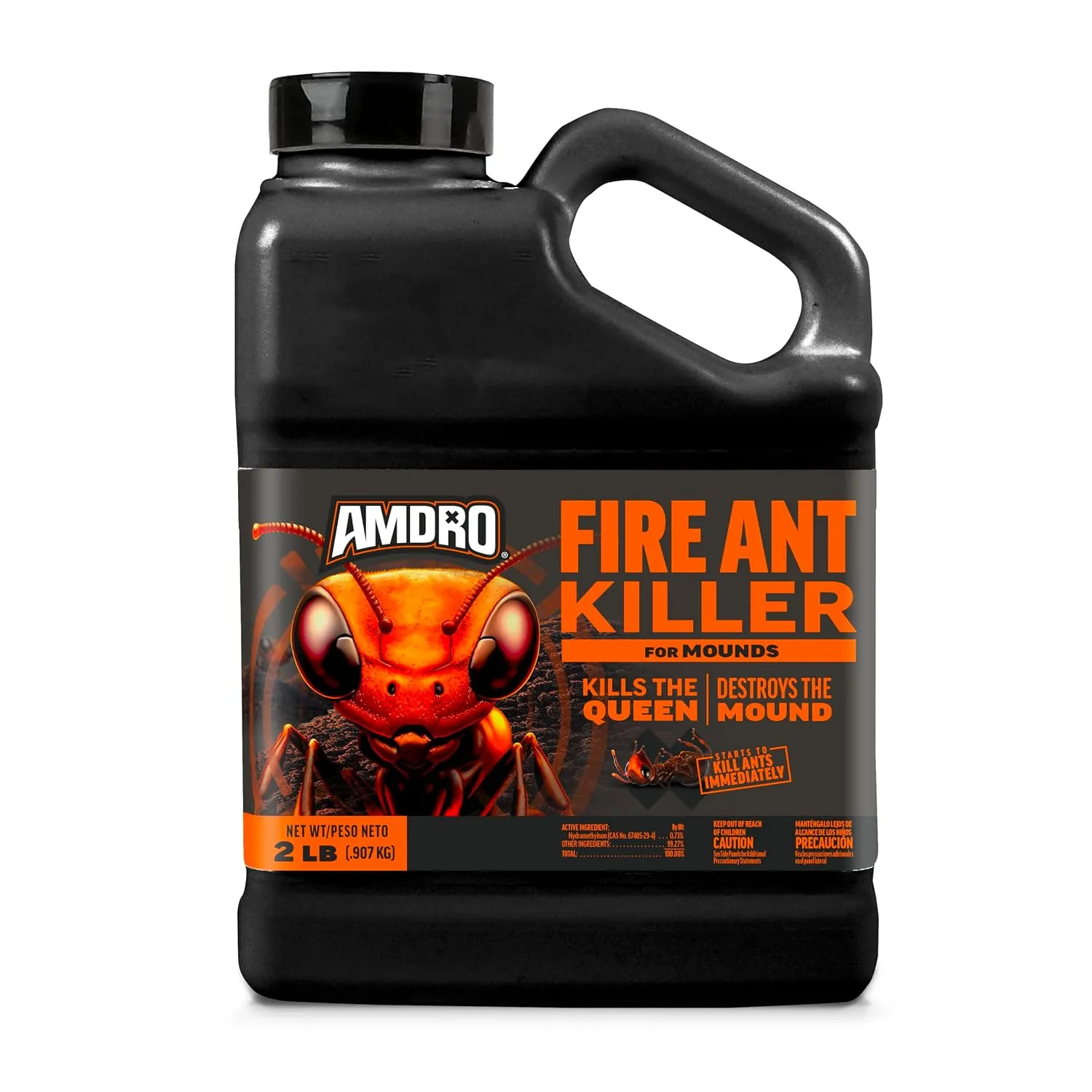
| Active | Hydramethylnon 0.73% on the registered bait label |
| Size | 2 lb (.907 kg) shaker jug |
| Carrier | Corn grit soaked in soybean oil |
| Mode of action | Prevents ants from converting food into energy |
| Speed | Label says the queen is dead in about a week. Texas A&M puts practical control at 2–6 weeks. |
| Rate | 2–5 level tablespoons per mound |
| Toxicity | Very low to people, animals and birds per the manufacturer. Toxic to fish — caution near ponds. |
| Key limitation | It is corn grit. When it gets wet the bait becomes soggy and is no longer appealing to fire ants. |
Amdro Fire Ant Killer for Lawns — broadcast bait
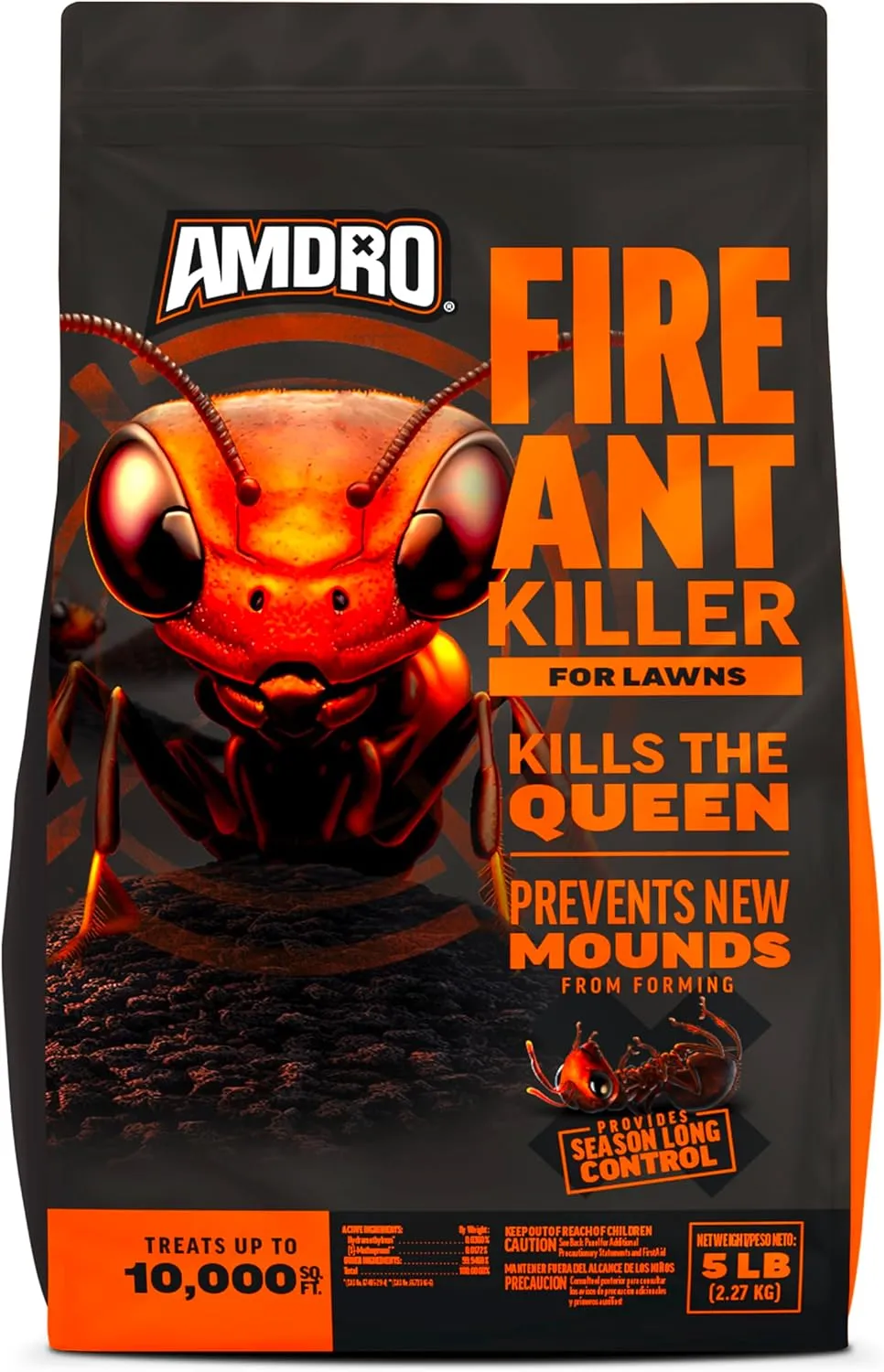
| Active | Two actives: hydramethylnon plus (S)-methoprene at 0.0025%, an insect growth regulator. Confirmed from the bag’s ingredient panel — this is the combination SKU, not the hydramethylnon-only formula. |
| Size & coverage | 5 lb (2.27 kg) — the bag states it treats up to 10,000 sq ft |
| Role | Whole-yard suppression, including colonies with no visible mound |
| Broadcast rate | Texas A&M gives 1–2 pounds per acre, or 2–4 ounces per 5,000 sq ft |
| Speed | Slower broadcast than applied to individual mounds — several weeks |
| Frequency | Two applications per year is usually needed |
Spectracide One-Shot Fire Ant Killer — bait, indoxacarb
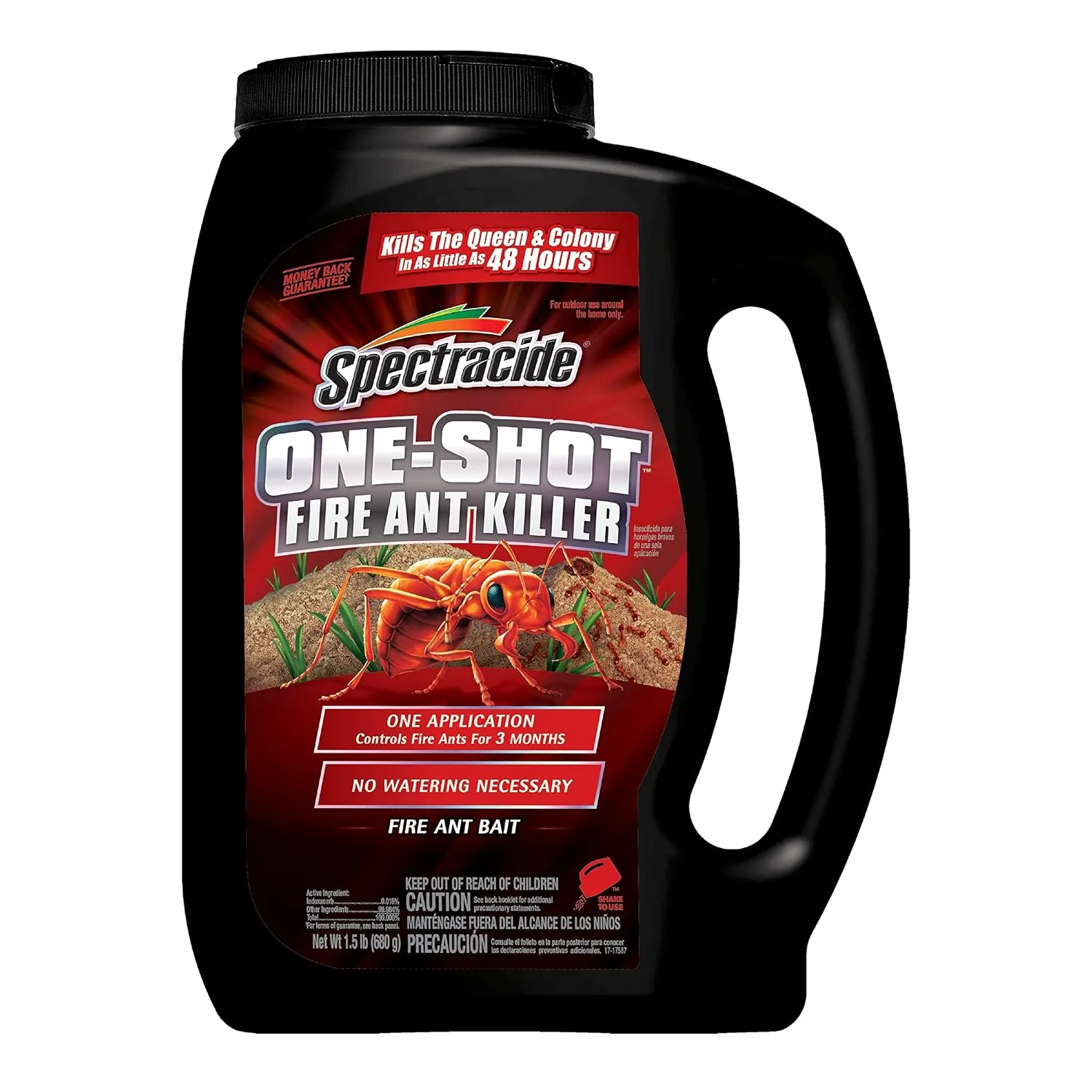
| Type | Bait — the front label says "FIRE ANT BAIT" in plain text |
| Active | Indoxacarb 0.016% (other ingredients 99.984%). Read off the container panel — no retail listing we reviewed named it. |
| Manufacturer claim | Queen and colony in as little as 48 hours; up to 3 months control from one application |
| Expected behavior | "You will initially see more ants." Decreased activity as soon as 24 hours after placement. |
| Size & coverage | 1.5 lb (680 g) treats 3,000 sq ft broadcast; a 5 lb size treats 10,000 sq ft |
| Watering | None necessary |
| Timing | Early spring or summer at first sign of activity, again in fall. Morning or evening when ants are foraging. |
Not one major retail listing we checked named the active ingredient for this product. We read indoxacarb 0.016% off the physical container panel. That is a useful lesson in itself: the front of a bag tells you what a product claims to do; the ingredient panel tells you what it is — and whether it duplicates something already in your garage.
"Spectracide" alone does not identify a chemistry — the brand spans gamma-cyhalothrin, indoxacarb and dinotefuran products depending on the SKU. Indoxacarb is also a different chemistry from Amdro’s hydramethylnon, so the two baits are not interchangeable if rotation matters to you.
Ortho Orthene Fire Ant Killer — contact dust, acephate
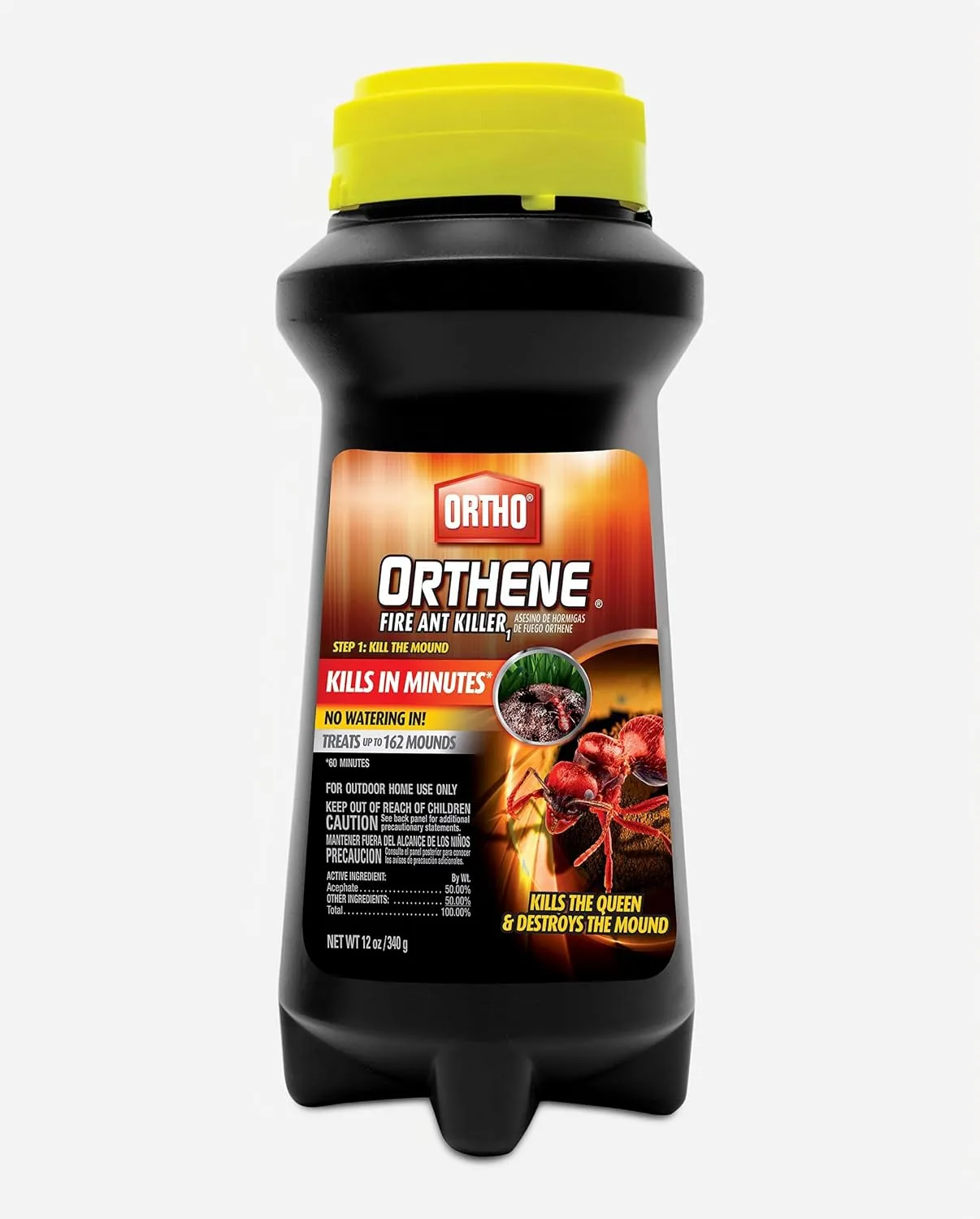
| Active | Acephate 50.00% (other ingredients 50.00%) |
| Chemical class | Organophosphate — a cholinesterase inhibitor. A different class from everything else here. |
| How it works | Workers track the powder deep into the mound, where it also kills the queens |
| Speed | Front label claims "kills in minutes," asterisked to 60 minutes. Workers within hours; colonies destroyed within 3–7 days. |
| Size & rate | 12 oz (340 g), 1 tablespoon per mound, treats up to 162 mounds. A 14 oz size treating up to 189 mounds also exists. |
| Handling | Harmful if swallowed. Moderate eye irritation. Avoid breathing dust. Chemical-resistant gloves, long pants, long-sleeved shirt. |
| The other thing | Acephate has a strong, persistent odor. Competitors market "no odor" products specifically against it. |
It is an organophosphate, not a pyrethroid — different mode of action, different toxicity profile, and label handling requirements that are genuinely more demanding. It is also the most effective single-mound product here, which is why it has survived in the market for decades.
Treat the PPE line on the label as instructions rather than boilerplate. Applying a 50% organophosphate dust in shorts on a breezy afternoon is how people get exposed.
Ortho Fire Ant Killer Mound Treatment — contact granule, bifenthrin
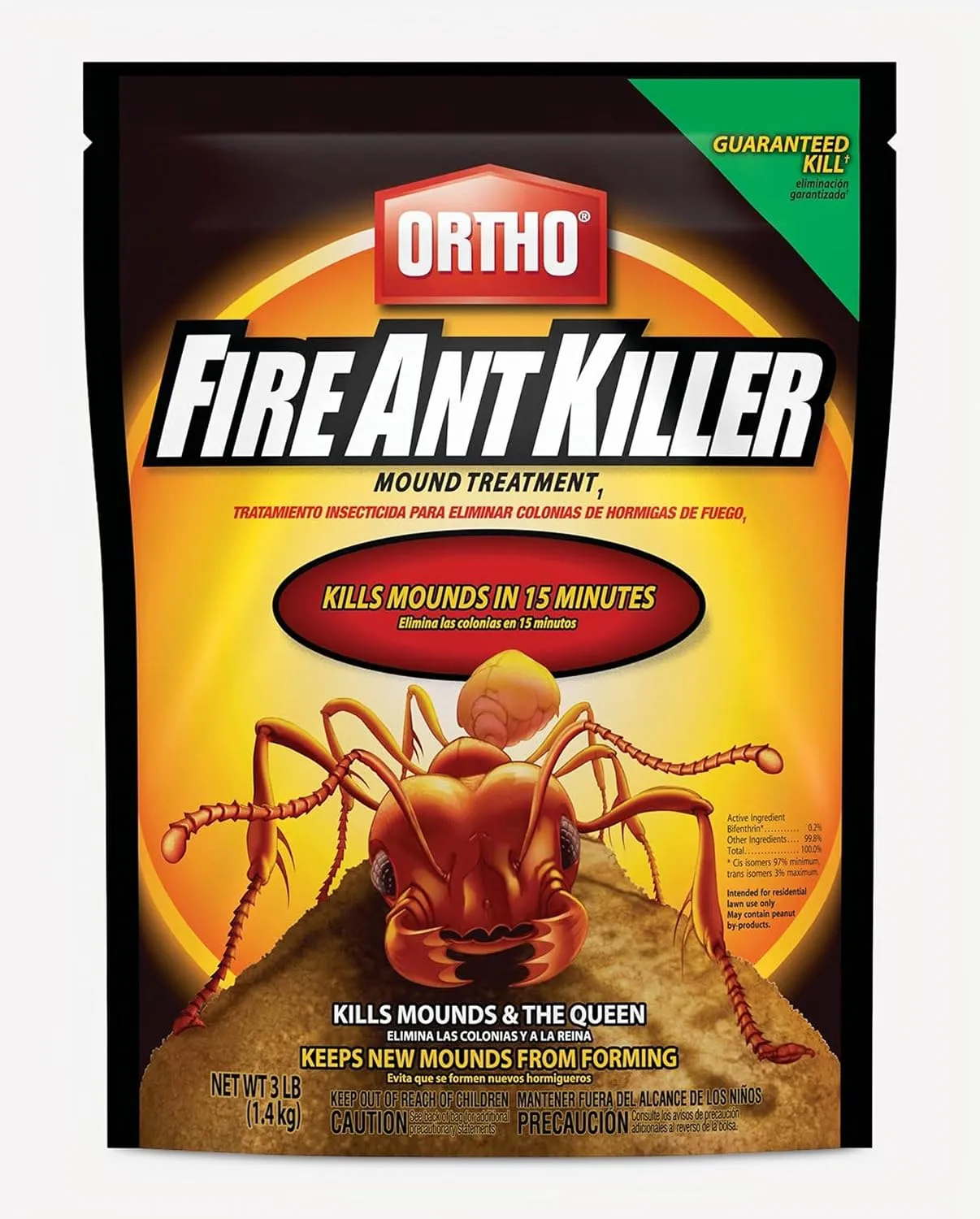
| Active | Bifenthrin 0.2% (other ingredients 99.8%) |
| Chemical class | Pyrethroid — destabilizes nerve cell membranes |
| Size | 3 lb (1.4 kg). Intended for residential lawn use only. |
| Speed | Front label claims mounds killed in 15 minutes |
| How it works | Penetrates the soil below the mound |
| Where | Lawns, landscape areas, flower beds, patios, sidewalks, driveways |
| Allergen note | The bag states it may contain peanut by-products. Worth knowing before handling if there is a peanut allergy in the household. |
| Note | Pyrethroids can persist in the environment longer than pyrethrins and their derivatives |
Timing: The Bait Window
Alabama Extension is specific: baits should be applied when ants are actively foraging, which means when temperatures are between 70°F and 95°F, and not before or after a rain.
| Condition | Requirement |
|---|---|
| Air temperature | 70°F to 95°F |
| Soil temperature | Foraging slows below 65–70°F and above 90°F |
| Rain | Not before or after. Amdro bait is corn grit — wet bait stops being appealing. |
| Ground condition | Apply when ground and grass are dry |
| Mid-summer | Late afternoon or early evening — foraging drops in the heat of the day |
| Best seasons | Spring and fall. Two applications per year is the standard program. |
Standard extension practice, and it takes half an hour. Put a potato chip or a bit of hot dog on the ground near a mound. If ants find it within 20–30 minutes, they are foraging and the bait will work. If they ignore it, you would be spreading money on the lawn.
The Mistake That Wastes the Most Bait
Alabama Extension is explicit about this and almost no consumer content mentions it. Fertilizer spreaders do a great job of applying fertilizer but are not capable of applying fire ant bait in the small amounts recommended per acre. Even if you could close the gate far enough, the bait is oily and will compact, so it will not flow freely through the hopper. Extension's conclusion is that common fertilizer spreading equipment is not recommended with fire ant baits.
You need a low-volume spreader designed for bait. Texas A&M lists "requires low-volume spreader" as a stated disadvantage of Amdro bait for exactly this reason.
The broadcast rate is 1–2 pounds per acre — about 2–4 ounces per 5,000 square feet. That is a tiny amount spread very thinly, which is precisely what a fertilizer spreader cannot do.
The other common errors
Applying bait before or after rain
Wet bait is not attractive. You spent the money and the ants ignore it.
Applying when it's too cold or too hot
Ants aren't foraging. The bait sits there and degrades.
Watering in a bait
Ruins it. Baits are not granular insecticides.
Disturbing the mound before treating
Scattered colonies are harder to control and may relocate.
Expecting bait to work overnight
Baits are slow by design — the delay is what gets it to the queen.
Panicking when ant activity increases
Spectracide's own label says you'll initially see more ants. That's it working.
Treating only visible mounds
Broadcast bait reaches colonies with no visible mound. Mound treatment doesn't.
Broadcasting contact insecticide yard-wide
Kills native ants that compete with fire ants, which can make reinvasion easier.
Using old bait
Amdro holds effectiveness for a limited period after opening. Buy what you'll use.
Skipping the fall application
Two applications a year is the standard program, not one.
The Two-Step Method
Texas A&M describes the approach plainly: individual mound treatment is reserved for colonies that are a nuisance or that remain following a broadcast bait application.
Broadcast bait across the whole yard when ants are foraging. Reaches colonies you cannot see. — Amdro for Lawns, or Spectracide One-Shot broadcast
Wait. Give the bait time to work through the colonies. Weeks, not days.
Treat what's left — only the mounds that remain, or the ones you cannot tolerate: by the door, the play set, the mailbox. — Ortho Orthene, Ortho Mound Treatment, or Amdro for Mounds
Repeat spring and fall. Back to step 1.
Broadcast bait alone leaves you waiting weeks while a mound sits next to the back steps. Mound treatment alone treats only what you can see — and a yard with visible mounds has many more colonies you cannot see, including newly mated queens that have not built a mound yet. Running both, in order, is what every extension service in the Southeast recommends.
Which to reach for
| Situation | Product |
|---|---|
| Whole yard, spring or fall program | Amdro for Lawns — broadcast bait |
| Whole yard, want one product for both jobs | Spectracide One-Shot — labeled for broadcast and mounds |
| A specific mound, want colony kill, not in a hurry | Amdro for Mounds — bait |
| A specific mound, needs to be gone today | Ortho Mound Treatment — bifenthrin, ~15 minutes claimed |
| A stubborn mound that survived other treatments | Ortho Orthene — acephate. Strongest option, most PPE. |
| Near a pond or stream | Read every label. Hydramethylnon is toxic to fish; pyrethroids are highly toxic to aquatic life. |
| Vegetable garden | Check each label for edible-crop restrictions. Several are not labeled for it. |
Safety and Environment
A pesticide label is not a marketing document. It is a federally enforceable legal document, and applying a pesticide inconsistently with its labeling is a violation. That includes the site, the rate, the PPE and the restrictions near water. Everything on this page is background. The label on the bag you bought governs.
| Product | Key label points |
|---|---|
| Amdro (both) | Very low toxicity to people, animals and birds per the manufacturer. Toxic to fish — caution near ponds and lakes. |
| Spectracide One-Shot | Read the label — the active ingredient was not stated on retail listings we reviewed. |
| Ortho Orthene | Harmful if swallowed. Moderate eye irritation. Avoid breathing dust. Gloves, long pants, long sleeves. |
| Ortho Mound Treatment | Pyrethroid. Highly toxic to aquatic organisms as a class. Keep out of storm drains and water. |
| All of them | Keep children and pets off treated areas per the label reentry statement. |
Pollinators and native ants
- Pyrethroids as a class are highly toxic to bees. Follow label directions near blooming plants.
- Baits are more selective by design — the bait has to be found and carried by foraging ants, so non-target exposure is narrower than a broadcast contact insecticide.
- Native ants compete with fire ants. Broadcasting contact insecticide across a whole yard kills them too, which can leave the yard more open to reinvasion.
- That is another argument for the two-step method: targeted bait plus targeted mound treatment, rather than blanket spraying.
The Encyclopedia of Alabama puts it bluntly: it is impossible to eradicate fire ants in Alabama now that they are established across the entire Southeast. The goal is suppression, on a schedule. Two bait applications a year, spring and fall, with mound treatment as needed in between, is what a maintained yard looks like. Anyone promising permanent elimination from a single application is selling something.
Quick Reference
| Item | Value |
|---|---|
| Bait application temperature | 70–95°F |
| Foraging slows below / above | 65–70°F soil / above 90°F |
| Rain | Do not apply before or after |
| Ground condition | Dry |
| Mid-summer timing | Late afternoon or early evening |
| Broadcast rate, hydramethylnon bait | 1–2 lb per acre; 2–4 oz per 5,000 sq ft |
| Amdro per mound | 2–5 level tablespoons |
| Orthene per mound | 1 tablespoon; 14 oz treats up to 189 mounds |
| Spectracide One-Shot coverage | 1.5 lb = 3,000 sq ft; 5 lb = 10,000 sq ft broadcast |
| Amdro bait speed | Queen in about a week per label; 2–6 weeks practical control |
| Orthene speed | Workers in hours; colony in 3–7 days |
| Ortho Mound Treatment speed | ~12–15 minutes claimed |
| Spreader | Low-volume bait spreader — not a fertilizer spreader |
| Program | Two bait applications per year, spring and fall |
| North Alabama ant | Usually the S. invicta × richteri hybrid |
| Goal | Suppression, not eradication |
Frequently Asked Questions
Sources & References
- Alabama Cooperative Extension System, "Managing Fire Ants with Baits" — bait application at 70–95°F and not before or after rain; broadcast bait managing mature colonies as well as young colonies with no visible mound; 1–2 lb per acre rate; and the finding that fertilizer spreaders cannot apply bait at the small rates required, that the bait is oily and compacts so it will not flow freely, and that common fertilizer spreading equipment is not recommended with fire ant baits.
- Texas A&M AgriLife Extension, fireant.tamu.edu — hydramethylnon 0.73%; broadcast rate 1–2 lb per acre (2–4 oz per 5,000 sq ft); 2–5 level tablespoons per mound; 2–6 weeks practical control; two applications per year; the low-volume spreader requirement; and the two-step description reserving individual mound treatment for nuisance colonies or those remaining after broadcast bait.
- University of Tennessee Extension, PB1739 and the UT fire ant product list — foraging slowing below 65–70°F soil temperature or above 90°F; mid-summer application in late afternoon or early evening; application when ground and grass are dry; bifenthrin classification; acephate as an organophosphate cholinesterase inhibitor; pyrethroid environmental persistence relative to pyrethrins.
- USDA APHIS, Imported Fire Ant Program Manual — the S. invicta × richteri hybrid found from the middle of Mississippi and Alabama northward into eastern Tennessee; reduced cold-weather colony activity and longer development times in cooler regions; and the quarantine covering movement of hay, soil, plants and soil-moving equipment.
- Virginia Tech Extension ENTO-593, "Hybrid Fire Ants in Virginia" (May 2024) — the hybrid zone including Georgia, Alabama, central Mississippi and Tennessee, and hybrids appearing more cold-tolerant than either parent species.
- Mississippi State University Extension, "Fire Ant Facts" — northern migration likely limited by cold; hybrids similar in biology and behavior to the parent species; mounds taller and more durable in heavy clay than sand.
- Encyclopedia of Alabama, "Imported Fire Ants" — activity between 70 and 90 degrees; mounds appearing in cool or moist weather and possibly absent during hot dry summers; and that eradication in Alabama is impossible now that fire ants are established across the Southeast.
- University of Arkansas Cooperative Extension FSA7036 and MP144, and LSU AgCenter household insect publications — Ortho Orthene classified as an acephate dust; the product/active-ingredient index showing multiple chemistries under the Spectracide brand; and the distinction between hydramethylnon-only Amdro products and hydramethylnon plus s-methoprene combinations.
- Product labels and manufacturer sources: EPA registered master label for Amdro Fire Ant Bait; Amdro.com product FAQ (corn grit carrier, wet bait no longer appealing, toxic to fish); Spectracide.com One-Shot product page (bait mechanism, more ants initially, coverage and timing, 48-hour and 3-month claims); H-E-B listing reproducing the Ortho Orthene label panel (acephate 50%, 1 tablespoon per mound, 3–7 day colony destruction, PPE statements); DoMyOwn and Ortho listings for the bifenthrin mound treatment.
- Notes and limits: the Spectracide One-Shot active ingredient (indoxacarb 0.016%) and the Amdro for Lawns two-active panel (hydramethylnon plus (S)-methoprene 0.0025%) were read directly off the product containers in August 2026, because no retail listing reviewed named them. Sizes, coverage figures and hazard statements in the product tables likewise come from the physical labels. Manufacturer speed claims (12–15 minutes, 48 hours) are reproduced as claims; extension figures (2–6 weeks for bait) reflect field control. Amazon listings can be relinked to different SKUs — confirm the product matches before purchase. Nothing here is pesticide application advice; the label on the container you purchased governs legal use, and your county Extension office can advise on specifics.