This page contains Amazon affiliate links. If you buy through them we may earn a commission at no extra cost to you. How we make money →
Advion vs Advion Evolution — The One-Line Answer
Indoxacarb 0.6%. Identical active ingredient, identical mode of action, identical transfer effect.
The bait matrix — a revised balance of sugars and proteins, and their type.
German cockroaches evolved to avoid sweet baits. Evolution's matrix is Syngenta's direct answer to bait aversion.
Never baited here before? Either works. Baited here and it stopped working? That is exactly why Evolution exists. Buying your first tube today? Evolution, since it is the same chemistry in a better-eaten matrix.
Check Advion Cockroach Gel on Amazon →
What Indoxacarb Actually Does
| Active ingredient | Indoxacarb 0.6% |
| CAS number | 173584-44-6 |
| EPA registration | 100-1484 (Advion Evolution). Read from the product label. |
| Concentration | Indoxacarb 0.6%, other ingredients 99.4% |
| Pack format | 4 × 1.06 oz (30 g) non-refillable syringes, with plunger and tips |
| Chemical class | Oxadiazine — a different class from pyrethroids, organophosphates and neonicotinoids |
| Manufacturer | Syngenta |
| Formulation | Non-staining, odorless gel that does not run, in a syringe |
| Repellency | Non-repellent — this matters enormously. See the mistake section below. |
| Shelf life | Up to five years stored indoors with minimal temperature and humidity fluctuation |
| Labeled species | German, American, Australian, brown, smokybrown, Oriental, brown-banded and Asian cockroaches |
| Labeled use sites | The Evolution label covers residential, institutional, commercial and industrial areas — single and multi-family buildings, hospitals, food-handling establishments, transport and more. Check the label for your specific site. |
The MetaActive effect — why it is selective
Syngenta describes indoxacarb as a pro-insecticide: it must be metabolized inside the target pest before it can be activated. That is a genuinely different design from a contact spray, and it explains the safety profile.
The cockroach eats the bait. At this point the indoxacarb molecule is not yet the toxin.
Specific insect enzymes bio-activate the molecule by breaking it at sites that fit the enzyme.
That reaction produces smaller metabolites with powerful insecticidal properties.
Those metabolites block the sodium channel of the insect nervous system.
Syngenta puts it directly: the conversion of the indoxacarb molecule into its more insecticidal form can only take place through interaction with the insects' enzymes. The product arrives as something that is not yet an insecticide, and the cockroach turns it into one.
That is the mechanism behind the selectivity, and it is why the safety data reads the way it does — see the safety section.
Advion vs Advion Evolution, in Detail
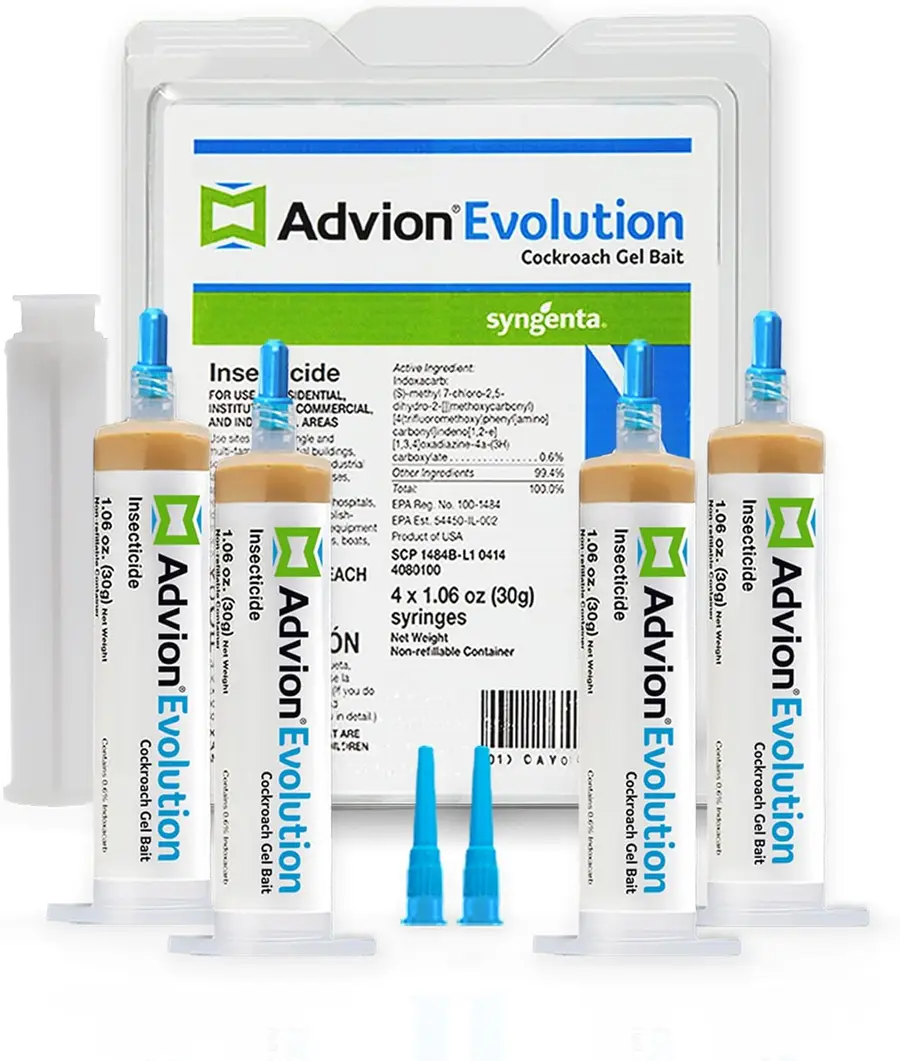
| Advion Cockroach Gel | Advion Evolution | |
|---|---|---|
| Active ingredient | Indoxacarb 0.6% | Indoxacarb — the same |
| What changed | — | The bait matrix |
| The change | — | A revised balance of sugars and proteins, and their type |
| Purpose | — | Increased attraction, higher consumption, faster kill — and specifically to prevent potential bait aversion |
| Non-staining, odorless, non-repellent | Yes | Yes |
| Transfer effect | Yes | Yes |
Bait aversion is real, and it is behavioral not chemical
Cockroach populations under sustained pressure from sugar-based gel baits developed aversion to the very sugars used to attract them. Pest management literature routinely refers to bait-averse strains.
This is a behavioral resistance problem, not a chemical one. The insecticide still works perfectly well — the roach simply will not eat it. That distinction matters, because the fix is not a stronger poison. It is a different matrix.
The published trial data
| Measure | Original | Evolution |
|---|---|---|
| Consumption by bait-averse German cockroaches, 24 hours | 39 mg | 98 mg |
| Mortality at 7 days | 81% | 100% |
| Speed of kill on a bait-averse strain | — | Improved by 8 days over the original |
These are Syngenta's own palatability and efficacy trials, reported through trade publications. They are not independent research. The figures are directionally consistent across sources, but treat them as the manufacturer's data rather than as a neutral finding.
The Transfer Effect
| Level | Mechanism |
|---|---|
| Primary | A cockroach eats the bait directly and dies. |
| Secondary | Other cockroaches eat the feces or the carcass of the poisoned roach and are poisoned in turn. Indoxacarb remains active after digestion. |
| Tertiary | Roaches that feed on those secondary victims are also killed. Syngenta claims this third level is unique to Advion. |
A spray kills what it contacts on open surfaces. But the large majority of a German cockroach population is inside a void — behind a dishwasher, in a cabinet joint, inside an appliance motor housing — and never crosses your treated surface.
Bait works in the opposite direction. A few foraging roaches carry the dose into the harborage and distribute it to insects you will never see or reach. Nymphs in particular feed on adult feces, which is how the dose reaches the part of the population that never forages at all.
That inversion is the entire argument, and it is why professionals bait rather than spray for German cockroaches.
The tertiary-kill exclusivity claim is Syngenta's, about its own product.
Which North Alabama Roach Do You Actually Have?
Advion is labeled for essentially every pest cockroach species. But where the problem comes from changes the strategy completely.
A German cockroach infestation is an indoor breeding population. Bait is the correct primary tool. A smokybrown or American cockroach problem is usually an outdoor population coming in. Bait helps, but exclusion and moisture control are the actual fix.
Getting this wrong is why some people bait diligently and still see roaches every fall.
| Species | Where it lives | How to know |
|---|---|---|
| German cockroach | Indoors only — kitchens, bathrooms, appliance voids, cabinet joints. Breeds indoors and never leaves. | Small, tan, two dark stripes behind the head. Seen in the kitchen at night. This is the one Advion is best at. |
| Smokybrown | Outdoors — tree holes, mulch, leaf litter, gutters, attics, crawlspaces. Very common across the Southeast. | Large, uniform dark mahogany, strong flier. Shows up indoors seasonally, often one at a time. |
| American | Sewers, drains, crawlspaces. The "palmetto bug." | Very large, reddish-brown with a lighter figure-8 marking behind the head. |
| Oriental | Damp, cool places — crawlspaces, basements, drains, under slabs. | Dark, almost black, slow-moving, prefers damp. |
Why North Alabama sees what it sees
| Regional factor | Effect |
|---|---|
| Heavy tree canopy and mulched landscaping | Prime smokybrown habitat. They live in tree holes and leaf litter and fly to lights. |
| Crawlspace construction | Extremely common here, and a classic harborage for American and Oriental cockroaches — dark, humid, and connected to the house by plumbing penetrations. |
| Tennessee Valley humidity | Every peridomestic species does better in it. |
| Long warm season | Extended outdoor activity and a longer window for seasonal intrusion. |
| Fall cooling | The classic trigger for outdoor species to move indoors. |
| Multi-family housing | German cockroaches move between units through wall voids and plumbing chases — the same problem as bed bugs. |
One large roach in the bathroom in September, and none the next week, is almost certainly a smokybrown or American that came in from outside. That is an exclusion and moisture problem, not an infestation.
Several small tan roaches in the kitchen at night, and more the following week, is a German cockroach population. That is what bait is for, and it will get worse without treatment.
The species tells you which situation you are in. It is worth catching one to look at rather than guessing.
Application
German cockroaches forage short distances from harborage. A large blob of gel in the middle of a cabinet is out of range for most of the population.
Twenty small placements distributed into cracks, corners and hinge points contact far more of the population than one big one — using the same amount of product. Think of it as covering the map, not delivering volume.
Where to place it
| Where | Note |
|---|---|
| Inside cabinet corners and along the back edge | Where the vertical and horizontal surfaces meet |
| Hinge points and cabinet door corners | Cockroaches follow edges |
| Under and behind appliances | Refrigerator, dishwasher, stove — warm motor housings are prime harborage |
| Under the sink, around plumbing penetrations | Moisture plus a wall-void entry point |
| Behind and under drawers | — |
| Not on open flat surfaces | Cockroaches avoid open ground, and it is a needless exposure risk |
| Not anywhere children or pets can reach | Cracks and voids only |
How much
| Spot size | Small — roughly a pea or less. The Australian label references about 5 mm diameter, around 0.1 g per spot. |
| Density | That label calls for at least 2 spots per square metre, up to 5 for heavy infestations or if American cockroaches are the main pest. |
| US label | Governs. Rates and units differ between countries. Read the label on the tube you bought. |
The rate figures above are from the Australian Advion Evolution label, included to convey the scale of a correct placement — not as a US rate.
Follow-up
- Inspect placements after several days. Bait that has been eaten needs replacing; bait that is untouched is in the wrong place.
- If placements are being consumed heavily, keep them stocked. Running out mid-program wastes the momentum.
- If nothing is being eaten anywhere after a week: wrong placement, a competing food source, or bait aversion.
- Expect to see more activity initially as roaches move to feed. That is the bait working, not failing.
- Clean up competing food. A kitchen with crumbs and grease under the appliances is offering a better meal than your bait.
- Reapply as placements are consumed or dry out. Gel dries over time, especially in warm dry locations.
The Mistake That Ruins Gel Baiting
This is the single most common reason gel baiting fails, and it is entirely avoidable.
Advion is non-repellent by design — cockroaches will walk onto it and feed. Most consumer aerosol and residual sprays are pyrethroids, and pyrethroids are repellent. Spray near a bait placement and you contaminate it. The roaches now avoid the entire area, including your bait. You have spent money to make your bait unattractive.
It also kills the foraging roaches that would have carried the dose back into harborage — destroying the transfer effect that is the main reason to use this product at all.
Pick one approach. If you are baiting, stop spraying in that area.
The other errors
Spraying repellent insecticide near bait
Contaminates it. Roaches avoid the whole area.
One big blob instead of many small ones
Most of the population never encounters it.
Placing bait on open surfaces
Cockroaches avoid open ground. Also a needless exposure risk.
Cleaning with strong chemicals where you baited
Same contamination problem.
Leaving competing food available
Your bait competes with the crumbs under the stove and loses.
Giving up when activity increases
More visible roaches early is bait working, not failing.
Not replenishing consumed placements
The program stalls halfway through the population.
Using the same matrix indefinitely
Rotating matrix is how professionals manage bait aversion.
Baiting a smokybrown problem
Outdoor species need exclusion and moisture control.
Ignoring adjacent units in an apartment
German cockroaches move between units. Coordination is usually required.
Storing the tube in a hot car or garage
Shelf life depends on stable indoor temperature and humidity.
Placing where children or pets can reach
Cracks and voids only.
Safety
| Statement | Source |
|---|---|
| Based on animal testing, no biologically significant effects are expected from skin or eye contact or by ingestion | Syngenta SDS |
| If swallowed: first aid measures are not normally required | Syngenta SDS |
| If in eyes: rinse with water; first aid measures are not normally required | Syngenta SDS |
| Syngenta emergency line | 1-800-888-8372 |
A clinical trial protocol on environmental control as add-on therapy in childhood asthma specifies Advion (indoxacarb 0.6%) gel bait as the primary insecticide for cockroaches, describing it as highly successful in cockroach abatement.
Cockroach allergen is a significant asthma trigger, so these are homes with infestations and children with asthma — about as cautious a selection context as exists. The protocol still specifies sensible handling: bait applied in the smallest quantities to achieve an effect, targeted to infested areas, and not placed in areas easily accessible to children and pets. That is a reasonable standard for a household to adopt.
Practical handling
- Place only in cracks, crevices and voids — never where children or pets can reach it.
- Use the smallest quantity that does the job. More gel is not more effective; more placements are.
- Wash hands after handling.
- Follow the label for permitted sites, particularly around food preparation surfaces.
- Store indoors at stable temperature and humidity. Not the garage, not the truck.
- The label is the law — it is a federally enforceable document and it governs over anything on this page.
For completeness: the SDS also records case reports of methemoglobinemia and renal failure in adults who intentionally ingested large quantities of the product. That is an entirely different exposure scenario from normal household use.
Quick Reference
| Active ingredient | Indoxacarb 0.6% (CAS 173584-44-6) |
| Class | Oxadiazine |
| Mode of action | Pro-insecticide — bio-activated by insect enzymes, then blocks the insect sodium channel |
| Marketing name | The MetaActive effect |
| Repellency | Non-repellent |
| Transfer | Primary, secondary and tertiary kill |
| Original vs Evolution | Same AI; Evolution has a revised sugar and protein matrix |
| Why Evolution exists | Bait aversion in German cockroaches |
| Shelf life | Up to 5 years stored indoors at stable temperature and humidity |
| Placement principle | Many small placements beat a few large ones |
| Where | Cracks, crevices, corners, hinge points, under and behind appliances |
| Where not | Open surfaces; anywhere reachable by children or pets |
| Early result | More visible activity as roaches move to feed |
| The big mistake | Spraying repellent insecticide near bait placements |
| If nothing is eaten in a week | Wrong placement, competing food, or bait aversion |
Species strategy
| You have | Do this |
|---|---|
| German — small, tan, striped, in the kitchen, increasing | Bait is the primary tool. Advion is well suited. Expect a multi-week program. |
| Smokybrown — large, dark, occasional, seasonal | Bait helps, but exclusion and moisture control are the fix. Check gutters, mulch depth, crawlspace vents, door sweeps. |
| American — very large, reddish, from drains or crawlspace | Same, plus drain and crawlspace attention. Higher bait density per the label. |
| Oriental — dark, slow, damp areas | Moisture control first. |
| Apartment or multi-unit | Notify management. German cockroaches move between units. |
Frequently Asked Questions
Sources & References
- Syngenta Professional Pest Management product and label pages for Advion Cockroach Gel Bait and Advion Evolution Cockroach Gel Bait — that Evolution features the same active ingredient with an enhanced bait matrix designed to prevent potential bait aversion; the non-staining, odorless, non-repellent formulation; the labeled species list of German, American, Australian, brown, smokybrown, Oriental, brown-banded and Asian cockroaches; and the storage note that under ideal indoor conditions the gel can last up to five years.
- Syngenta PPM Australia — that the difference is the new bait matrix, and specifically the revised balance of sugars and proteins and their type; and the MetaActive mechanism, in which indoxacarb is a pro-insecticide that must be metabolized within the target pest, with insect enzymes bio-activating the molecule by breaking it at specific sites, producing metabolites that block the sodium channel of the insect nervous system.
- Syngenta PPM EAME — the selectivity explanation that conversion of the indoxacarb molecule into its more insecticidal form can only take place through interaction with the insects' enzymes, and the species list identifying German cockroaches including gel bait-averse strains.
- Syngenta Advion Cockroach Gel Bait Safety Data Sheet — indoxacarb technical, CAS 173584-44-6, 0.6%; the first aid statements; and the Syngenta contact number 1-800-888-8372.
- Professional Pest Manager and Globe Pest Solutions — the palatability trial figures (98 mg of Evolution consumed versus 39 mg of the original by bait-averse German cockroaches over 24 hours; 100% versus 81% mortality at seven days; improved speed of kill by 8 days on a bait-averse strain); the tertiary kill description and Syngenta's exclusivity claim; and the Australian label rate guidance of at least 2 spots per square metre up to 5 for heavy infestations or where American cockroaches are the main pest, at approximately 5 mm and 0.1 g per spot. These trial figures are manufacturer-generated data reported through trade publications, not independent research. The Australian rates are included to convey scale; the US label governs US use.
- Clinical trial protocol NCT02251379, "Environmental Control as Add-on Therapy in Childhood Asthma" — specifying Advion (indoxacarb 0.6%) gel bait as the primary cockroach insecticide, describing it as highly successful in cockroach abatement; quoting the SDS that based on animal testing no biologically significant effects are expected from skin or eye contact or by ingestion; noting case reports of methemoglobinemia and renal failure in adults who intentionally ingested the pesticide; and specifying that bait be applied in the smallest quantities to achieve an effect and not placed where children and pets can easily access it.
- Limits and caveats: the label is the law and governs over anything on this page. The tertiary-kill exclusivity claim is Syngenta's, about its own product. Evolution's exact matrix composition is proprietary. Bait aversion is well documented in German cockroaches but its extent varies by population. Species habitat characterization for North Alabama is drawn from general regional knowledge; no county-level cockroach survey data was located. This page is not pest control advice — application decisions should follow the label and, where uncertain, a licensed professional or your county Extension office.